
Here we have Annie, who I’ve expressed concern about before much to the chagrin of trolls, 24 days ago:
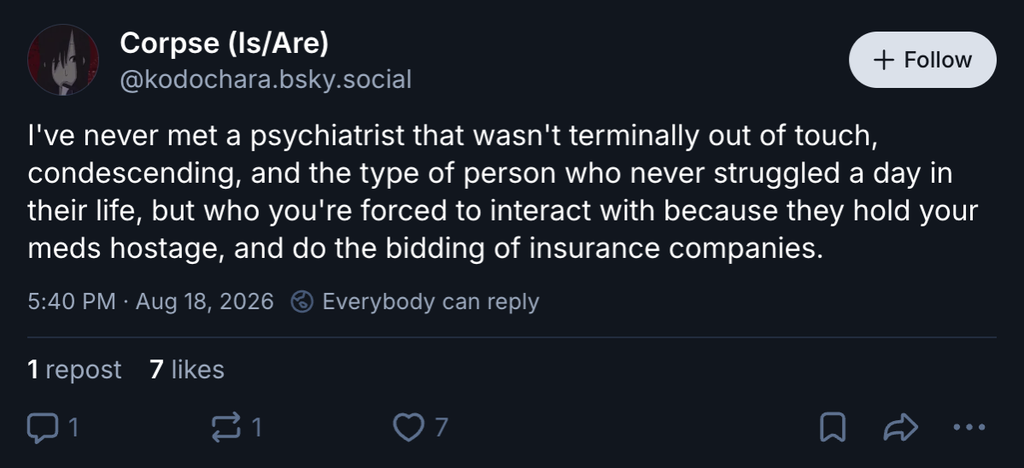
And here’s Annie 2 days ago:

Click For Text Format
Corpse (Is/Are) @kodochara.bsky.social
Annie talk to dad about finding place. Wants her to wait until tomorrow to contact psychiatrist. Annie also has regular therapist appointment tomorrow.
3:17 PM • Sep 9, 2026 • Everybody can reply
2 likes (1 comment)
That shows the date, but there’s more:
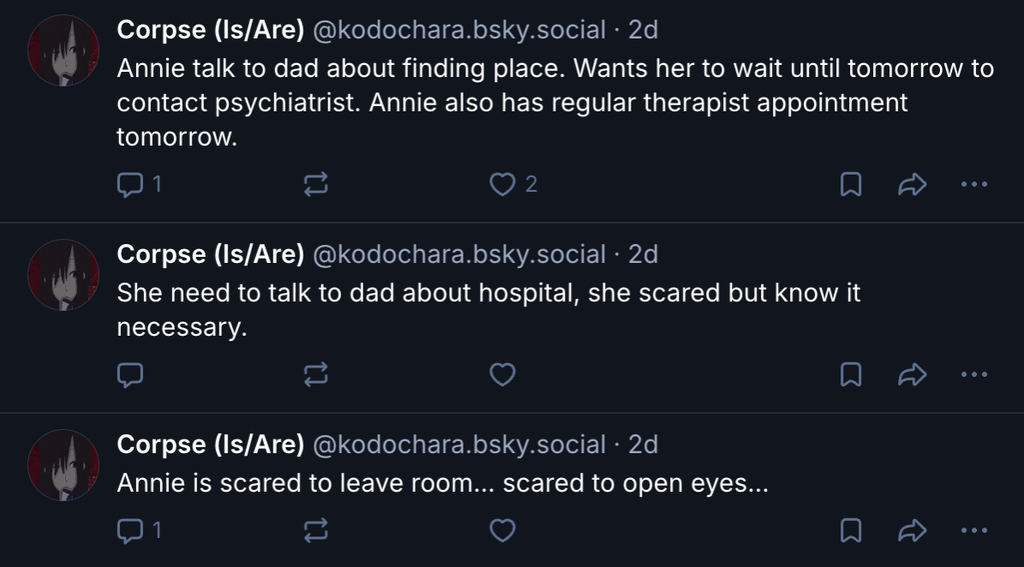
Click For Text Format
Corpse (Is/Are) @kodochara.bsky.social • 2d
Annie talk to dad about finding place. Wants her to…
[previous post] She need to talk to dad about hospital, she scared but know it necessary.
[previous post] Annie is scared to leave room… scared to open eyes…
Here’s also Annie, on the same day:
![Someone posted this in my server... I might cry... hearing stuff like this makes all of this worth it.
[image]
batman @nomanimbatman.bsky.social • 2d
🤔
Corpse (Is/Are) @kodochara.bsky.social • 2d
Believe me, I ensured them that you do appreciate it.
Corpse (Is/Are) @kodochara.bsky.social • 2d
[image below]
Corpse (Is/Are) @kodochara.bsky.social • 2d
But I'm glad to see you communicating. I don't want you to even think otherwise even as an insecurity.
Corpse (Is/Are) @kodochara.bsky.social
[image below]](https://asherwolfstein.com/wp-content/uploads/2026/09/2026-09-12-14.22.37-bsky.app-05e5662f7279-696x1024.png)
Click For Text Format
Corpse (Is/Are) @kodochara.bsky.social • 2d
Someone posted this in my server… I might cry… hearing stuff like this makes all of this worth it.
[image]
batman @nomanimbatman.bsky.social • 2d
🤔
Corpse (Is/Are) @kodochara.bsky.social • 2d
Believe me, I ensured them that you do appreciate it.
Corpse (Is/Are) @kodochara.bsky.social • 2d
[image below]
Corpse (Is/Are) @kodochara.bsky.social • 2d
But I’m glad to see you communicating. I don’t want you to even think otherwise even as an insecurity.
Corpse (Is/Are) @kodochara.bsky.social
[image below]

Click For Text Format
SkrunklySappho 6:27 PM
annie, you’re deserving of a lot more than that. like i said, you’re a fuckin’ hero. you’re so selfless and altruistic even when the people you’re trying to help don’t appreciate it, it’s amazing to see
1❤️ response 3 👆 responses
Annie 6:28 PM
To be clear, I think Bella definitely appreciates it, if anything, I think she’s scared that she’s responsible for my failing mental health, when it’s actually her abusers that keep gaslighting me.

Click For Text Format
I am Annie’s age regressed headmate, only eight.
Annie try to help 18 year old girl named Bella, very bad people abuse Bella and hurt her, she also in debt, Annie stand up to bad people, but bad people gaslight Annie, they create fake accounts posing as Bella’s friends, they try to convince her Bella hates her. Annie has mental breakdown over misunderstand, now they both very scared and traumatized. Annie scared of hurting Bella or anyone else, so she go to mental hospital to make sure she okay in brain.
Jeanne | Guardian APP 4:56 PM
Bad people taunt Annie, they say she pushed Bella back into sex work. They send this message, taunting her for not taking down article exposing her for abusing kids. Someone threaten to doxx Annie and leak her nudes to.
Now, before I continue, I must make something extremely clear, because my detractors like to muddy it all up.
This is in no way intended as a comment on Annie being a transgender woman.
This is in no way intended as a diagnosis, as I’m not a psychologist/psychologist/therapist. This is in no way intended to minimize Annie’s suffering or mental state, as I’m sure emotionally it’s quite real. This is in no way intended to comment on whether Annie has or doesn’t have a condition, or whether she is or isn’t suffering.
These are social media posts, so I have no fucking idea.
If that’s how you want to interpret this, and my intentions, then okay, but I just told you what they are, so, that’s gonna be *your* interpretation, not a fact of *my* intentions.
With that very clearly said,
There’s two parts here that concern me.
One is the way the eight-year-old regressed headmate is presented. It gives very much this:

I remember quite vividly being eight, and I know for a fact I didn’t talk like this when I was eight. One of my female friends in 3rd grade, which I attended when I was eight, and who I still remember also turned out to be in a household that was abusive, and she didn’t talk like this either. I don’t remember a single other third-grader talking like this and not putting on affectations. When I was eight, things like having Kelsey Doudna explain to me that men put their penises in women’s vaginas (which, I already had the vague idea by living on a ranch), or making jokes with ketchup and hot dogs about Loreena Bobbit, or discussing the intricacies of Maniac Mansion for the NES, or which horror movie character would outlast all the rest were going on. Not, “Me good kid! Me be happy now! Me do homework and not get reward.”
That’s because it’s an affectation. Pure affectation, in my layman’s opinion. And when someone is putting on severe affectations, well, that’s called something in the literature. But, being a layman I’m not going to pretend to *know* any of that for certain.
In fact, if you’d like to know more, you can read an explaination why I say this in grave detail below.
What I do know is that it’s important. Even if it is a caricatured affectation, that doesn’t mean the emotions aren’t there. That doesn’t mean the trauma isn’t there. It just means something isn’t lining up realistically.
Secondly, we have the second series of screenshots. From what I can understand Jeanne is Annie’s regressed alter. But notice that when Jeanne posted those messages in the Discord, Annie describes herself (or whoever she decides she is at that moment) as *her* posting those messages.
But, when she says that, she’s not putting on the very obvious affectations of Jeanne. So, who’s talking and who’s posting?
Annie’s talking, and Annie’s posting, by my layman’s estimation.
And here’s the thing. Again, I don’t *actually* know this, or have the expertise to *know* this. I’m not pretending to *know.* These are pure speculations that cause me to wince and recoil in abject horror, and not at Annie herself, because she’s clearly in pain, but at how this whole affective role-play seems to have come about.
But before we get to that, let me explain what’s led *me* to offer these speculations.
If I didn’t know much about mental health, I probably would not offer them at all. This would seem, odd, but, hey, whatever, disorder, right? But, as everyone knows now since I’ve said it a dozen times, I’ve been hospitalized 18 times now since I was 18 years old. Several times in the *acute ward.* This does *not* make me an expert by any means, but it does offer a number of observations and experiences that otherwise may be inaccessible.
One of my stays I made a point to talk to a schizophrenic patient for extended periods. That’s when I first hand experienced genuine “word salad,” and why I take that phrase so personally as offensive. It’s not because I’m offended at someone suggesting I’m schizophrenic, as there’s nothing wrong with that. It’s that someone is throwing around a pitiable mental health symptom as an insult, when, I know for a fact what I write is comprehensible because other people comprehend it, just not the troll in question. Obviously, “schizo-posting,” which Annie uses liberally and to describe my online activity, falls under this umbrella.
In several stays, I witnessed inexplicable agitation and restraint. Fuck, in early stays I was relegated to the ‘quiet room’ myself until I could demonstrate self-control to their standards. Which I did, and for the most part, still do, because that turned out to be useful for me and led to a much better life. In my most recent stay I witnessed a man work himself up all morning, becoming more and more agitated, yelling, flailing, and talking to the pictures on the walls because someone *in his head* had come back to taunt and torture him. Note how it wasn’t to help him express anything or come across a certain way.
These are just things I’ve observed first-hand. Also, one time I thought I was a rat (from space), and the therapists/doctors called it delusional, at first thinking I was high on drugs (I wasn’t). And even given that, I never thought the people trying to help me, telling me I was an “at-risk” adult, were more out-of-touch with reality than I.
It. Just. Doesn’t. Line. Up. To me. Not to me.
Why go to a hospital if everyone there is a condescending jerk and more disconnected from reality than you?
Also, the times I was hospitalized, like this last time, were because I couldn’t function in my life, even from hour-to-hour. This last time, two days prior, I couldn’t stop talking. Literally. And the day before I almost leaped out of my car to fight with someone while driving in a parking lot, losing my shit. And the day of I was experiencing my fourth crash of the day because “I couldn’t hydrate despite drinking two pitchers of water” and “felt like I was dying” calling my mother to plead for her to come to Fort Collins because I just couldn’t figure this out even with Maus there.
Just sayin’. I know it looks different for everyone, but, *sigh* just sayin’. That’s what I got. Here’s what it looks like for Annie:

However, in Annie’s case, we have Jeanne talking about how Annie’s “afraid to leave room” and “afraid to open eyes,” on the same day that Annie is posting about how wonderfully altruistic and selfless she’s told she is while writing, “I posted this about you,” while *not* talking like Jeanne.
I expressed concern over this before. And I do so again, because, regardless of what Annie may or may not have done, they are a person whose pain deserves some consideration, like *everyone.* What she’s accountable for, what she might be guilty of, who she might’ve hurt (I have no idea) can all be dealt with appropriately later. I’m not saying Annie is a “good person,” or “redeemable,” as I don’t even think like that. And someone else’s lack of crisis isn’t someone else’s decrease in legitimate victimhood. Christ, you guys gotta get fucking boundaries.
By the way, *this* is the ‘virtuous pedophile’ that Liana Kerzner is friends with:
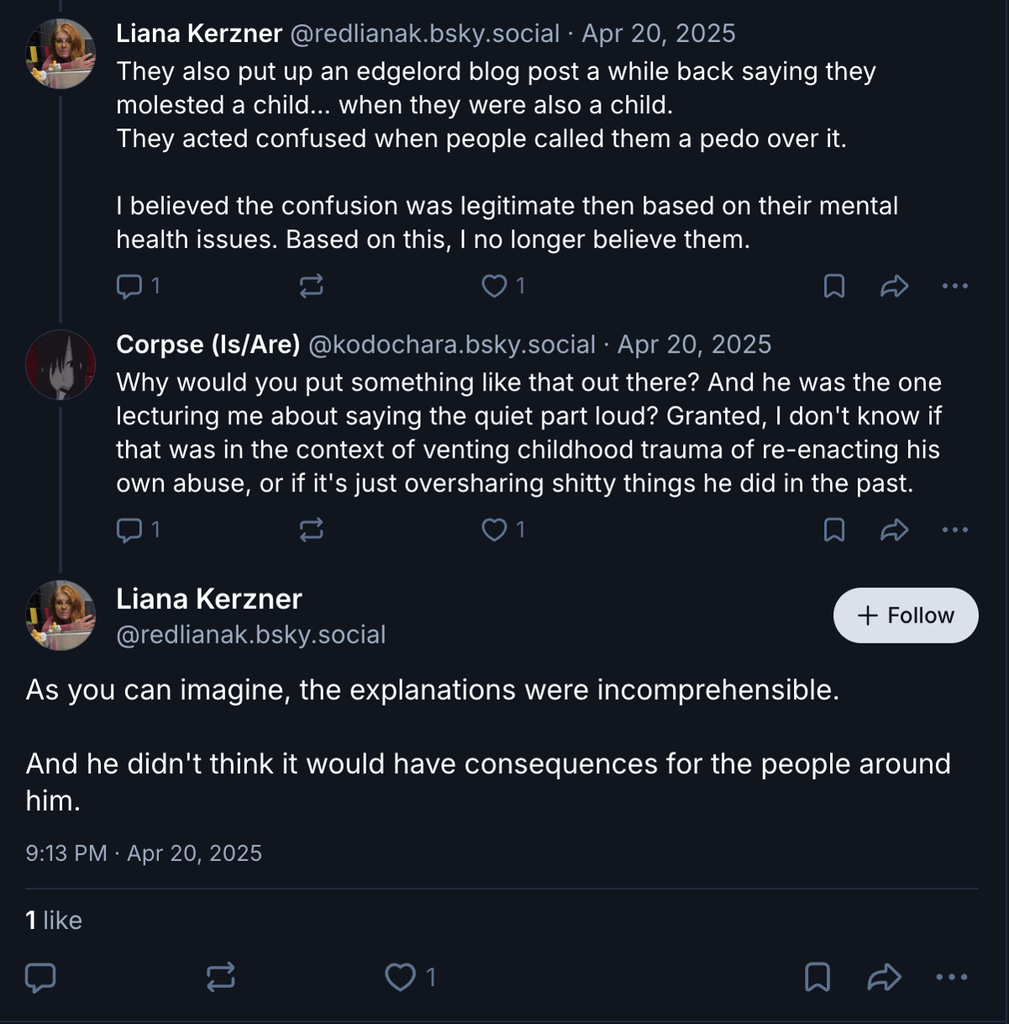
While she critiques me for “being on Kiwi Farms” (I’m not), for my husband flirting with furries on Second Life that are “too young for him” (they’re in their thirties), mentioning we live in a small two-bedroom apartment for some bizarre reason (classism), and for me being “insane” because I think I’m an “animal person.” (Note that she was aware of the space-rat thing that I no longer believe, but which had professionals diagnosing me with Zoanthropy and telling me I was “at-risk”), and with this awareness, she made a point to tell police that very detail, and who tells others that we are two squicky incompetent basement-dwelling buffoons.
Don’t believe the police call point thing? Not the Liana *YOU* know? Well, listen for yourself:
Liana describes things like this as part of a “pack of lies” and her husband puts it in quotes as “evidence.” Nothing posted will ever be enough to “count” to the Kerzners, which, should inform you when subscribing to their judgments.
At least someone like Annie isn’t my friend.
Just sayin’.
But… how did we get here?
Well, I personally trace it back to Poppy Diabolique of, wait for it, the L’Enfant Diabolique System. Yes, Poppy, otherwise known as Jessica Bryce Routhier, a licensed therapist in the Michigan area, and someone Liana Kerzner also defended vehemently:
Given Liana’s treatment of me, and all the lies she’s told, demonstrably, I’ll leave it to you to decide what that is worth.
So, yes, Poppy is only one alter within an intricate system of alters known as the “L’Enfant Diabolique System.” In fact, some sketchy reports say that, at one time, Jessica once, in person, rolled her head around, bonking it against a dresser and then “became” her underage Thai sex worker alter (I believe?) and it was as laughable as if it was in an independent early 2000s movie, or say, my play On Being Different. But, please, take that with a grain of salt, after all, I’m only repeating what someone else said so, according to Liana Kerzner, I’m not responsible for saying it.
In fact, Jessica, when she was polyamorous as opposed to non-monogamous (which is what me and Maus are since our one nascent foray into polyamory was a complete and utter disaster and I decided NOOOOPE the first time), had a partner who *now claims* that Jessica is manipulatively abusive, and abused her, named Saige Alexis or, get this, the “VividFaeGarden System.”
Oh, that’s interesting.
Oh, by the way, Liana Kerzner said I was transphobic because I said that Jessica, in our only interaction was manipulative and exhibited specific manipulative behavior that I outlined.
In fact, when Saige and her now-wife Audrey approached me in bad faith (given how they deleted the *context of how they treated me* in “good faith,” like, wut? WUT!? just because you say it doesn’t make it good, unless you think like Kerzner or Jessica), completely ignored my explanation for how I *wasn’t* comparing Saige’s behavior with Jessica’s, and then proceeded to flail in “my victimhood is the most important around!” telling me she knew “all about my situation” (from who? Kerzner? Poppy?) while, yes, her ALTER Cerise (or whoever she decided occupied her body at that time) didn’t even recognize my husband’s account. Her wife Audrey was ableist, diagnosing me as manic as a blue-collar worker with an expertise in package management, I guess. While Saige/Cerise were first sexist, and then racist (all deleted in “good faith” after a bizarro press release the next day), and then Cerise, quite publicly, made sure that *everyone* could see how she was protecting Saige by muting us.
It’s all quite connected, and performative-seeming, and… just, something isn’t right to me.
In fact, it *appears* to me that pretty much *anyone* with any kind of mental health issue associated with Jessica Bryce Routhier, a licensed therapist in Michigan, develops a “system” of “alters.”
Annie’s developed approximately last year or so. This is all very recent. I’ve watched it in real-time.
Now, I know that this Dissociative Identity Disorder is a thing. I’ve seen it. And, from what *I’ve seen,* regressed alters don’t talk like this. Remember, I worked for a year in an elementary school, with hundreds of kids and learned a thing or two about developmental psychology, as it was part of my job.
Click For My Long-Winded As Fuck Explanation
When considering typical monolingual English, this is not a realistic example of how an average eight-year-old child speaks. What stands out is that it mixes grammatical features typical of a much earlier stage, about the toddler or preschool years, with vocabulary, clause structure, causal reasoning, and discourse organization that are considerably more advanced. The entire thing sounds more like an older speaker intentionally using a schematic ‘little kid’ filter over otherwise mature language than like genuine child language.
Developmental literature makes the contrast very clear.
According to ASHA’s summary of Brown’s well-known research into grammatical morphemes, articles, the copular verb and the auxiliary be, the regular past tense, the third-person singular -s, and other aspects of English morphology are all forms that are generally acquired by the age of four. (ASHA) In their study of normally developing four-year-olds, Paul and Alforde found that production exceeded 90% for all but one of the grammatical morphemes that were tested. (ASHA Pubs) ASHA also states that the use of grammatically correct and increasingly complex sentences is already to be expected by the ages of four to five. (ASHA)
By the age of eight, the question of whether children can say that she is scared, that she goes, or that an eighteen-year-old girl is involved is usually no longer being considered. Researchers are now looking into the way in which eight-year-olds use complex clauses in both narrative and expository speech. A study of normally developing children aged 8 to 11 found that there was a considerable amount of syntactic complexity and longer, more complex utterances, especially in narrative situations. (PubMed) Recent developmental research has also shown that seven- and eight-year-olds produce more syntactically complex narratives than younger children and that from about six or seven years of age children are able to construct stories that are logically connected and include explicit causal relationships. (ASHA Pubs)
That point is especially important in this case since the passage I’m examining is in fact a narrative explanation, which is precisely the kind of situation in which a child of eight years old would normally show more rather than less of their syntactic abilities.
Here is what happens phrase by phrase:
| Passage | Linguistic feature | Developmental significance |
| “Annie try to help 18 year old girl” | Missing 3sg -s; missing article an | Characteristic of immature/telegraphic morphology, not typical age 8 |
| “she also in debt” | Copula is deleted | Copula omission is strongly associated with very early child English |
| “Annie stand up” | Missing stands or past stood | Tense/agreement underspecification |
| “they create fake accounts posing as Bella’s friends” | Participial clause + possessive determiner | Considerably more syntactically sophisticated |
| “they try to convince her Bella hates her” | Infinitival complement + embedded proposition; hates correctly inflected | Mature syntax and correct 3sg agreement |
| “Annie has mental breakdown” | has correctly carries 3sg agreement, but article a disappears | Internally inconsistent morphosyntax |
| “over misunderstand” | Bare verb apparently substituted for noun misunderstanding | Doesn’t resemble a normal productive developmental error at age 8 |
| “they both very scared and traumatized” | Missing are | Early-style copula deletion |
| “Annie scared of hurting Bella or anyone else” | Missing is, but retains gerund complement of hurting and coordination | Primitive surface grammar wrapped around mature structure |
| “so she go to mental hospital” | Missing goes and a/the | Very early-looking morphology |
| “to make sure she okay in brain” | Purposive infinitival subordinate clause, but embedded copula deleted | Especially revealing mixture |
| “she pushed Bella back into sex work” | Correct irregular/past-tense morphology and adult semantic relation | Mature |
| “this message, taunting her for not taking down article exposing her for abusing kids” | Multiple embedded nonfinite clauses | Far beyond telegraphic syntax |
| “Someone threaten to doxx Annie and leak her nudes” | Missing 3sg -s while coordinating two infinitival complements | Again, sophisticated syntax with arbitrarily infantilized agreement |
And that’s all well and good, but the most compelling evidence isn’t that Annie’s alter isn’t a realistic eight-year-old, after all Annie’s disturbed. Instead, it’s the internal inconsistency.
The writer apparently “knows” third-person agreement because the passage says:
“Bella hates her”
and:
“Annie has mental breakdown”
Yet elsewhere it gives:
“Annie try”
“Annie stand”
“she go”
“Someone threaten”
There is no typical stage of development in which the grammatical system has not yet been acquired; the supposedly childish feature is turned on and off while more difficult grammatical constructions remain unchanged.
The same applies to the copula. Forms equivalent to:
“she in debt”
“they very scared”
“Annie scared”
“she okay”
This is very similar to the kind of English that young children use. Research into the acquisition of the copula verb specifically mentions examples like ‘I in the kitchen’ in children of about two years of age. (Benjamins) Wouldn’t a child know their age?
Yet this does not mean that all utterances lacking a copula constitute ‘two-year-old speech’—other dialects and different languages have their own grammatical systems—however, in the case of standard monolingual English it is an early feature.
The same thing is true of omitting articles, auxiliaries, copulas, and inflections—that is precisely what linguists and speech-language researchers refer to as telegraphic speech, for example “Ball under”, “Doggie go” and “More toy”, since these contain a disproportionate number of content words while the grammatical or functional elements vanish. (PubMed Central (PMC))
Crucially, the researchers regard this as a stage that occurs when children are combining words for the first time, and telegraphic output is normally spoken by children at the prelinguistic, one-word, or two-word stage—not typically by school-age children. (PubMed Central (PMC))
Annie is mimicking telegraphic style speech.
But, crucially, it doesn’t really resemble true telegraphic speech.
In genuine early telegraphic language there are limitations throughout the child’s developing grammatical system.
But, here, we see the writer is able to produce:
“they try to convince her [Bella hates her].”
and:
“taunting her for [not taking down [article [exposing her [for abusing kids]]]]].”
The second one has a number of layers of syntactic embedding; even if the missing article is ignored, it includes an adjunct participial clause (taunting her…), a prepositional gerund complement (for not taking down…), a participial modifier (exposing her…), and another gerund complement (for abusing kids).
I’d like to imagine that I can say that this is definitely not the type of speech toddlers use, unless they’re an unusual savant. Maybe Jeanne is an idiot-savant? Who knows!
Continuing, there are even more problems, like an obvious mismatch in vocabulary. The recurring expressions “bad people” and “okay in brain” seem to be an effort at semantically simplifying the language in a childlike way. Yet they are found alongside:
- abuse
- in debt
- gaslight
- fake accounts
- posing as
- mental breakdown
- traumatized
- sex work
- doxx
- leak her nudes
- article exposing her
A child of eight is certainly capable of learning unusual words since development depends on exposure and there is no magical age limit that stops a child from knowing the terms gaslight or doxx. I don’t base my judgment of authenticity solely on vocabulary, but since this alter only appeared in, I believe, the last year according to Annie (she was “new” for a time to the “system” thing, which, uh…) then the amount of time Jeanne had to learn these is quite small.
What stands out to me is the way the language is distributed. The speaker seems to have a fairly sophisticated adult-level conceptual understanding of Internet harassment, impersonation, psychological manipulation, psychiatric hospitalization, sexual exploitation, public exposés, doxxing, and threats involving nonconsensual intimate images, even though they lack such basic English expressions as she is, she goes, eighteen years old, and a mental breakdown.
The two developmental profiles are not, and cannot be, combined naturally.
Thus, we must ask, even at this juncture, is this an eight-year-old frozen in time by a traumatic event? Or is this what Annie *thinks* an eight-year-old *is like*?
The narrative cognition is also very atypical of an eight-year-old. For example, its causal structure is quite extraordinary:
Bella is abused, Annie then interferes, the antagonists trick Annie, a misunderstanding leads to the situation breaking down, Annie then worries that she might be causing harm, and this results in her being hospitalized, after which the antagonists take advantage of the situation and the threats increase.
Children who are typically developing and aged between seven and ten years old (I love third graders by the way, they are so funny) are certainly able to produce causal narratives, and research shows that causal discourse is common in that age group. That point is believable.
What is not plausible, in my layman’s opinion, is expressing that perfectly coherent causal model through randomly regressed morphology.
I therefore describe the style as pseudo-telegraphic infantilization rather than as genuine eight-year-old speech, in my sole layman’s opinion alone.
Here’s how it sounds more like an affectation than an actual eight-year-old, even a psychologically traumatized one:
Morphological stripping involves the removal of inflectional endings which tend to give language a “grown up” flavor, for example “tries” is changed to “try” and “goes” is changed to “go” whilst threats is changed to threaten.
The omission of function words involves the disappearance of copulas and determiners: instead of ‘she is scared’ one says ‘she scared’, and instead of ‘an eighteen-year-old girl’ one says ‘eighteen-year-old girl’. This is one of the most recognizable traits of ‘primitive’ or very young speech.
Lexical infantilization involves ordinary ways of expressing oneself being replaced by terms such as ‘bad people’ [EDIT: hahahahaha] and particularly ‘okay in brain.’ The expression ‘okay in brain’ is obviously coded in a way associated with children rather than something that developmental research would expect an eight-year-old to say.
The basic adult syntax is retained. Annie, or Jeanne, does not simplify the propositional or grammatical structure enough. Embedded clauses, purpose clauses, participles, coordinated elements, complements, referential tracking, and causal links remain.
The adult conceptual vocabulary stays put—terms such as gaslighting, being traumatized, sex work, doxxing, and so on are left alone while the basic grammatical structures are artificially taken away.
The application is inconsistent. Most strikingly, the same grammatical feature is at times objectively observed to be “known” and at other times it’s mysteriously missing: Annie tries but Bella hates; she goes but Annie has.
In my final opinion, this seems much more like a case of someone deliberately using the surface form to show that the language is childlike than something that could happen when a child is using a developing grammar: a mature linguistic structure is being overlaid with an adult cultural stereotype of immature speech.
There is indeed a precedent in the field of linguistics for telling the difference between real children’s language and adults’ ideas of how childlike language should sound. Ferguson’s classic study of “baby talk” pointed out that adults simplify their speech by omitting copulas, articles, prepositions, and inflectional endings. (ERIC) Subsequent research has also regarded “baby talk” as a distinct register with established features rather than just a direct reflection of what children actually say. (Benjamins)
Now, language disorders can cause problems with tense and agreement to appear much later than normal; research has shown that mastery of tense can be delayed past the age of seven in children with specific language impairment/DLD. (PubMed) So… perhaps in their presumed detailed research, as Jessica says she performed for her underage Thais sex-worker TIGERSHARK original charact- sorry alte- sorry, original charac- what the fuck is it?
Imaginary. That’s what it is, in my layman’s opinion alone.
Perhaps in her presumed research she most likely didn’t do Annie has determined that Jeanne has a specific language disorder.
Could she perhaps tell us what it is?
If it *IS* a disorder, well, it sounds like someone has taken mature propositions and run them through a stylized transformation, approximately like:
delete articles + delete BE + remove some 3sg endings + occasionally substitute childish circumlocutions = “child voice.”
The programmer in me just. can’t. stop.
Well… *sigh* what can you do?
Oh, also, Annie posts this, the day before:
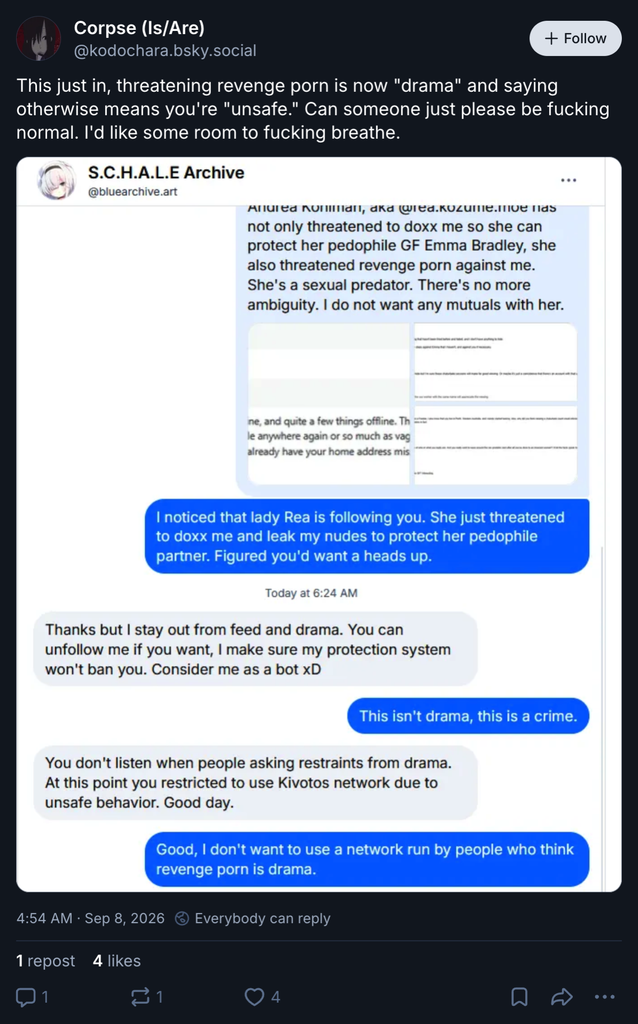
Well, considering how I’ve expressed myself, how I’ve made my case about privacy violations and *actually harassing me with the police*, which is criminal in Colorado by the way, and how Jessica, Saige, Audrey, and Annie (who called my posting “schizo-posting” and to which Liana made sure to spread a Kiwi Farms narrative), treats/treated all of it (Audrey called me a “broken nobody” while someone inside Saige said I was a “side-character at best” to… who? Saige? You gotta be kidding me. TROLLS DON’T MAKE YOU THE MAIN CHARACTER!)…
That’s what you get from other people.
Maybe if you actually had *ANY* regard, if *ANY* of them had *ANY* regard for anyone else outside of the people that are in their heads and their kinks, well…
Should’a thought’a that.™
Also, it might help if they weren’t constantly reinforcing the very kind of behavior Annie got back, where generally minor inconvenience/emotion = UNSAFE and must be QUARANTINED. Like me. Now she knows what it feels like I guess. Now she knows, this is what it feels like.