
Author: Asher Wolfstein
Published under the auspices of the University of Neo-Transylvania Experimental Research
This is Part 3 of a series titled Failed Abstractions: Interfaces Gone Wild.
In the study of semantic authority, source-to-source translation occupies an intriguing position since the output often remains linguistic in nature; as in, when a programmer writes a Dominant (surface-level) construct, the translator replaces it with constructs from a different, usually older or smaller, language, and the remainder of the toolchain then treats the generated Substrate source (lower-layer) as if it were a proper representation of the original Dominant. The transformation is often regarded as syntactic convenience (”syntactic sugaring”), and just as often, regarded as mere decoration, even though many of the expansions specify the evaluation order, the binding scope, the use of temporary storage, exceptional control flow, protocol selection, and resource behavior, all of which the original surface form deliberately left unmentioned. As a result, the generated Substrate code does more than simply restate the original Dominant; it becomes the first operationally detailed description of the construct and, in the absence of the architecture maintaining a more direct relationship, the Submachine construct, within the Substrate, thus gains authority over all subsequent analysis and execution despite the superficial programmer never seeing it, and the reconstructionist only able to assume the Dominant’s existence.
Bottom-Driven Semantic Monotonicity is a discipline for intentionally engineered Dominant Machines (higher-level, abstraction-reaching layers) as accountable, monotonic extensions of a selected Submachine (lower-level, more detailed machine), with stable support relations, projection consistency, preservation of inherited behavior, and a lower account for every newly introduced action. Applied to desugaring, this discipline neither prohibits a core-language view nor requires every downstream analysis to manipulate the richest surface syntax. Built into the abstractive framework, via the Dominance Condition of the Submachine, are the contracts that bind the generated structures (in either direction) to remain elaborations of a continuing construct identity, with introduced commitments and their originating rules represented as part of the system rather than relegated to optional source maps or compiler lore.
Why Surface Languages Are Expanded
By having a small semantic core, the number of cases in which an implementation must directly specify evaluation, typing, optimization, and code generation is reduced. Many surface constructs can be obtained using a single primitive binding operation; different looping forms can make use of the same iterator protocol; pattern matching can be compiled down to a series of tests and branches; closures can be converted into an explicit environment together with a callable record; and macros can generate whole families of ordinary expressions from brief descriptions. This kind of concentration can lead to both greater implementation efficiency and better formal reasoning, since the language designer can prove properties of a limited core and then show that each surface form expands into it via a stated preservation relation.
Practical benefits also extend far beyond mere simplicity. If a Dominant language (surface language) decides to use an existing language (a Substrate language), the new language does not have to start from scratch, but can instead reuse the compiler or runtime infrastructure. Instrumentation can be done at the source level; compatibility layers can transform a changing dialect into a fixed one; and a domain’s special notations can be reduced to general actions, without the need to develop a full backend system. None of these tasks must imply any Conceptual Dishonesty (see Translation As A Transfer of Semantic Authority).
On the contrary, a desugaring specification that clearly shows the order and effects it introduces can yield a more accurate semantics than the often found informal statement, such as “it behaves as expected”. The problem that then arises is what occurs after expansion: the Substrate artifact (generated artifact) becomes the real program, while the Dominant construct (surface construct) is left as no more than a location range and possibly a display name.
An Example: Iterator Expansion And Its Semantic Commitments
Take, for instance, a language having the Dominant structure:
for term in generate_collection(terms):
    process(term)
If the Substrate language includes lexical bindings, conditionals, normal calls, and a safe cleanup operation but not a fundamental (built-in) for, we could reasonably expect the Substrate generation to be:
let $sequence_17 = generate_collection(terms) in
let $iterator_18 = iterator($sequence_17) in
protect
    let rec $loop_19 = function ()
        let $step_20 = next($iterator_18) in
        if is_done($step_20) then
            unit
        else
            let term = value($step_20) in
            process(term);
            $loop_19()
    in $loop_19()
finally
    close_if_required($iterator_18)
Code language: JavaScript (javascript)
This Translation-Based Abstraction (expansion) accounts for a great deal that the Dominant syntax fails to show. The function generate_collection(terms) is evaluated only once; an iterator is obtained by means of a protocol operation; each invocation of next() yields either a completion marker or a value; the user’s binding is new for each iteration as determined by the language’s scoping rules; cleanup takes place after normal completion and, depending on how protect is defined; after an exceptional exit, the generated identifiers must not capture names from either the source context or the macro-expansion environment; and if any of the next(), process, or cleanup operations fail, there is a specific way in which the failure is propagated. Whenever iteration can be suspended, run concurrently, or detect mutations in the underlying collection, additional obligations are introduced by the expansion.
The Dominant construct is valuable, to a specific extent, since it bundles all these commitments into a single intelligible unit (this is in reference to the previously mentioned Platonism/Neo-platonism in the preceding entry). The desugared form is valuable because, in later stages, automated reasoning can be performed using a small set of known operations. Difficulty comes about when the Substrate recursion and cleanup generated become the semantically authoritative program for subsequent tooling.
The stack trace will point to $loop_19; the analysis will identify the resource effect as coming from the finally statement but without identifying the iteration rule involved; the optimization will inline next and transfer its semantics by way of the control flow graph; the debugger can determine the iteration step using source spans even though the runtime system consists of nothing but calls and jumps, and so on. The original form, being the for statement, continues to structure the programmer’s thinking, but the generated Substrate code drives execution. Traditionally, the connection between these two entities is treated as merely descriptive metadata rather than a constitutive semantic structure.
What An Equivalence Claim Must Contain
It is tempting to express the desugaring contract as , where expands the Dominant (surface) construct , but the symbol hides almost all of the interesting questions.
At least, to me!
Equality/Equivalence might consist simply in the attainment of the same final result by terminating and effect-free programs, OR it might also involve the preservation of divergence, the exception class and the location of exceptions, the order of externally observable operations, lexical scope, allocation observability, resource cleanup, cancellation, or concurrency interactions. With respect to macro systems, there arises another issue concerning syntactic context: operational equivalence can be achieved through ordinary execution by means of this Elaborative Translation (this expansion), yet it may affect name resolution, error messages, phase separation, or the ability of tools to tell Dominant (authored) text from Substrate (generated) text.
For instance, in the case of the iterator, a reasonable and justified contract based on Bottom-Driven Semantic Monotonicity would guarantee that the sequence will be computed only once, the values computed will be passed to process() in the exact sequence of the iterator, the loop will terminate on the exact point defined by the protocol, and so forth, at the very least.
Any time there is anything related to objective identity, time issues, memory usage, and security issues, the contract should state whether the generation of the iterator and closure is a semantic issue or just an implementation issue. A source-to-source translator can satisfy such a contract rigorously; to reiterate, the criticism developed here begins when further Submachines inherit the Elaborative Translation without inheriting an ordinary, inspectable account of the contract and the Dominant identity to which it applies.
The Characteristic Semantic Fractures
Drift rears its ugly head when an expansion introduces behavior undocumented by the Dominant, or when changes to the Substrate language cause the meaning of the generated construct to change. For instance, when close_if_required() can hide an exception from process(), a Dominant specification that describes iteration order alone is inadequate for the authority of the Elaborative Translation. Drift may also make a cameo when two different compiler versions choose different protocols and evaluation orders, yet still consider both Substrate artifacts as examples of the unchanged Dominant source construct.
In cases where behavior is distributed across the Substrate language specification, macro expander, core-language implementation, protocol methods, and downstream runtime, such that there is no owner of the composition of these artifacts, Opaque Responsibility is, unfortunately and often unintentionally, invoked, as such summonings tend to manifest. A resource leak might be attributed to the iterator, the expansion rule, an exception path, or the optimizer; each of these individual components may appear plausible since no single one records the causal chain as a single inspectable relation.
Epistemic Discontinuity occurs when the Dominant construct and the operations performed by the Substrate do not belong to the same identity system. Even though source maps can document ranges and hygienic macro systems can carry scope information, these are generally consumers of compilation, and consumed themselves, not constraints that would ensure the validity of the expanded program. When metadata is incomplete, optimized away, or unavailable to a tool, explanation falls back on that pesky, oft-ignored reconstruction.
Conceptual Dishonesty is clearly the best choice for the diagnosis, but it needs to be applied judiciously and reservedly. As written, Conceptual Dishonesty would describe a situation where a language or tool presents itself as having a simple operational identity but actually obscures some critical behavior necessary for the claim it makes about itself, or where Substrate control flow is represented as literally authored intent. Somewhere along these lines, the Dominance Condition of the Submachine unravels, and all restraints are unbound, leaving full transparency unsatisfied. Although a Dominant construct is permitted to omit details, in this case, its economy becomes misleading if the system depends on those details yet fails, sometimes spectacularly, and sometimes profitably, to provide users with an accountable means of accessing them.
The Objectivist Diagnostic
Under the Objectivist analogy introduced in the previous Translation As A Transfer of Semantic Authority, a Dominant construct (a Dominance) serves as a conceptual unit that integrates a class of operational cases. The “word” or syntax can legitimately omit the particular measurements of each realization—how many iterator objects are allocated, which addresses hold temporary state, how many lower steps a call requires—provided the omission remains contextual. In the ‘failure’ of source translation, as characterized here, and measured within the proposed framework, the integrating symbol survives while the originating unit and the measurements introduced through Elaborative Translation become auxiliary or invisible. While the programmer retains the notion of the loop itself, the Submachine performs the binding calls that have been generated, and neither need contain the hierarchically traversable structure tying the condensed unit to its referents.
Such an elegance I cannot recommend more.
Make no mistake, this is not an argument that a user must contemplate every generated temporary datum, truly, to comprehend iteration fully. Such a requirement would defeat conceptual economy. The diagnostic criteria posed by Objectivist Epistemology question whether the system, which here would be the abstractive contractual scaffolding, can discern the differentiated units, along with the rule applications, in order to facilitate integration, and whether an investigator can access them once the question surpasses the insubstantiality of the Dominant semantic “contract” with the programmer. The scope and expansion rule are computational analogs of the hierarchy that prevents a higher concept from “floating” free of its reality-bound basis: the irreducible Substrate of Submachine Zero and its Dominance Condition of ‘loving grace.’
Desugaring As Elaboration With Lineage
A semantic monotonic extension-oriented redesign would start by giving an unambiguous identity to the Dominance—loop:42—supported by accurate source spans and lexical context in which the loop is admitted. The redesign would further extend the system by adding a Projection structure/operation without removing the given identity. Every Substrate artifact (a Submission, in whole or in part) generated would be traceable to both its supporting artifacts and the rule that admits it:
loop:42
  ├─ sequence-evaluation:42.1   introduced-by iterator-expansion/v3
  ├─ iterator-binding:42.2      supports loop:42
  ├─ next-action:42.3           repeated-under loop-plan:42.p1
  ├─ item-binding:42.4          derives-from next-action:42.3
  ├─ body-application:42.5      supports source-body:47
  └─ cleanup-action:42.6        introduced-by iterator-lifetime-rule/v2
Code language: JavaScript (javascript)
Nodes can possess stable relations that are not derived solely from their source position estimates, even if the active compiler view compacts the Submachine syntax. The expansion rule defines which observations it keeps and which effects it adds; generated names form an explicit scope relation; an execution record mentions the plan’s version number and the identity of the generated actions; and a later optimization may supersede the recursive plan while retaining its predecessor relation and equivalence criterion. The Projection of the expanded model accurately represents the Dominant state honestly. It tells us that the actions of the Submachine ensure loop:42, but does not imply that there was recursion in the source or that the programmer wrote the generated cleanup herself.
Interpretive closure offers the implementation element to the above framework. In the Dominant iteration, there must be an explicit declaration of a sequence of low-level actions, or the use of resolvers that can provide reads, writes, protocol selections, and their outcomes. Transition preservation guarantees that the new Submission will not change the interpretation of the normal calls/bindings. The concept of Operator Blindness (which is a corollary of the Dominance Condition) ensures that the Submachine evaluator cannot favor a customized hidden case for each and every Domination; in this example, the Submissive iteration expresses its semantics via native mechanisms. Invalidating an expansion due to unsoundness will create an invalidation edge and allow a new plan without modifying the semantics of previous execution.
Costs, Limits, And Appropriately Binding Restraints
The inevitability of this lineage is that storage and coordination constraints are always imposed. As my father Scott would put it, “everything has a cost,” and this is the cost of implementation. Having fine-grained identities increases the number of artifacts; storing inactive expansions becomes a trade-off between compilation time and cache locality; execution logs may be too large; macro expansions can expose sensitive implementation details to a library’s client; and many other sources of boredom. Likewise, there must be a strategy for maintaining consistent identities under nondeterministic and evolving compiler builds.
However, pre-existing proofs could serve as shorter, more reliable alternatives to maintaining an unending permanent runtime record of every expansion step; simultaneously, some Substrate-bound artifacts could be reproduced from immutable source, versioned rules, and environmental stipulations rather than stored in full.
Therefore, the new design will require retention classes and access controls rather than exposing everything indiscriminately and without care. The actual state of the expansion may remain “hot” at compile time (as it is now), may be represented as a condensed support graph in release builds, and may even be reproducible based on a speculative cryptographic identity. A less assured deployment strategy could retain only the span lineage, thus reducing debugging assumptions. Generated proprietary content might ultimately be inaccessible to clients, but would still be available for inspection by authorized in-house tools.
Bottom-Driven Semantic Monotonicity cannot automatically decide these policies as a framework, and, in the specific, a structurally impeccable support edge can still encode a false claim if the expansion rule is wrong. Specific testing, proof, language specification, and implementation decisions remain essential.
Source-to-source translation can only succeed monotonically when the translation object is, or contains, a warranted operational account of the Dominance under an explicit context. It becomes a “failed abstraction” when the generated Submission acquires greater authority than its preservation contract and lineage can justify. This is an example of Elaborative Translation, which usually leads to unfortunate circumstances of Conceptual Dishonesty via Semantic Elaboration.
Elaborative expansion with lineage preserves the economic gains of being a smaller Substrate, but turns the Dominance, along with the commitments and consequences involved, into a single, unified throughline of machines.
On A Personal Note
My big song when writing this one was The Flesh Failures (Let The Sunshine In) from the original broadway cast of HAIR.
You know, as you sometimes do.
And, if you’re really listening, you know listening with listening, as opposed to without listening, you might notice the “backup” chorus are not singing the words that the lead(s) are. In fact, they sing:
Eyes look your last
Arms take your last embrace
And lips oh you the doors
Of breath… seal with
A righteous kiss
Seal with a righteous kiss
The rest is silence
And if that doesn’t ring familiar, because, it did not for me despite slogging through it way too early in like… 11th grade? 9th grade? I cannot remember, but I do remember the horribly arrogant and despicable Mr. Kunz who once gave my superlatively executed, beyond all comparison, sonnet (with hand-drafted calligraphy I learned the night before) a 99 because, and I quote,
Nothing’s perfect.
The dastardly Mr. Kunz who most likely thought James Taggart was the hero, like the rest of them.
Fuck you dude.
I hope you had to get a part-time job at Winter Park supervising the Alpine Slide queue like Mr. What’s-His-Name (he was so memorable I forgot his name) in 8th grade that never laughed at my incredible SNL-level skits (ahead of their time, for sure), at least, as far as I can remember.
I mean, we’re quote-singing Beck’s Where It’s At to showcase the scurvy experienced by Christopher Columbus’ crew.
Come the fuck on!
I suppose it can seem incredible what a properly trained memory can do, but it’s not without faults. It helps when you have to figure out how to train that memory because, otherwise, you won’t regret failing 7th grade, and we can’t have that can we? As I believe Epictetus says, “We suffer more in our imaginations than reality,” or some such like that, except in ancient Greek.
But, so as to not force anyone into a traumatized state of suspicion that a near-perfect recall of a moment of reality and *all* pertinent context leading up to it and after will come to bite them in the future (man, the words people don’t say!), it does sometimes fail.
Like, when I’m trudging through Shakespearean English the origin of which I *still* have no idea because *no one taught us how to fucking read it* outside of a few sentences and hand-waves, which, once again, thanks Mr. Kunz for the superb educational experience, and the words start to all run together…
And then, I find myself twenty-eight years and one dead dad later, listening to HAIR and discovering that, indeed, the background chorus is quoting Romeo & Juliet. Not only that, but, and this one I *did* recognize because we “analyzed” it at the *appropriate* level of Advanced Placement Literature & Composition, they quote Hamlet directly in What a Piece of Work Is Man / Walking in Space (Reprise) which… if you really look at the patchwork one-step-away-from-direct abstractive language and songs of the whole thing…
Really makes you realize that those imagined sufferings in your head, characterized by three stage clap-offs and furry trolls tiny-sexing in your LiveJournal comments to the tune of how ridiculously CRINGÉÉÉÉ your high school play On Being Different is, were really a giant derailment you never needed to take, after watching Straight To Hell and marveling at the surreal patch-work almost poem-quoting dialogue…
Espresso anyone?
Or, you know, 1989’s Dr. Caligari, a spiritual successor to The Cabinet of Dr. Caligari, being a 1920s German silent horror film, as one does.
There are times when a proper exposure to culture might’ve really helped with things instead of people thinking, “Oh, man, what the fuck is this, I have no idea what to do with it,” and then going, “Oh well,” and raising their arms up in exasperation and then… doing nothing… and then, years later, acting as if that is a perfect absolution for their lack of effort in my education, because this is America and teaching is such a sacred institution, even Mr. Kunz can do it!
But, I’m not bitter.
I’m just just.
It’s almost like, almost as if, just about, getting there, sort of like, perhaps, one might say, or… aw, fuck it, a 43-year-old weirdo might actually have lived a 43-year-long detailed private life consisting of intense heartbreak, desolation, wild fantasies (a few fulfilled), tears, sweat, and even a little blood, abandonment, disappointment, and even, hopefully “queerjoy” if I can fulfill just one more, just. one. more. and out-of-place experiences with predators and lovers while continuously digging into the nuclear waste of conflict for fun and profit, and just might *actually* know far more than your inflated-ego ‘parenting’ ass about things “just happening.”
In other words, sit down and shut the fuck up Volk. You won no friends or appreciation on *any* side… okay, I appreciated what you revealed, sure, but not your dismissive assertion that someone harassing me with the local police from an entire other country away “just happens,” you pissant little wannabe activist. Try mimicking hanging yourself with the controller again and looking exactly like how people imagine you look.
The audacity of short-sighted self-importance will never cease to amaze me.
You know, in the last song of HAIR, at least in the original broadway cast recording, there are the lines,
We starve, look, at one another short of breath,
Walking proudly in our winter coats,
Wearing smells from laboratories, facing a dying nation
Of moving paper fantasy, listening for the new told lies,
With supreme vision of lonely-tunes.

Somewhere, inside something, there is a rush of greatness,
who knows what stands in front of our lives.
I fashion my future on films in space.
Silence tells me secretly,

Everything.

Everything.
Mm-mm-mmm, Maaude! It’s byoooootiful!
HAIR starts with an interesting song titled Aquarius, as well that most everybody knows.
What some might *not* know is that, according to all the looney-tunes channeled ramblings of imposters, the Age Of Aquarius has already begun.
Maybe.
Some say, like, for example, math and science based on the globe’s axial precession, that it will occur between 2150 CE to 2597 CE, with the actual physical entry of the vernal equinox into the stunning constellation of Aquarius.
But, science, math? Booooring! Amirite? 9.9 Why let such unattainable details get in the way of Campbell-Jungian personal mythos?
Of course, a rare alignment of the sun, moon, and the first *six* planets of Aquarius led eager-to-rush-in-peace-and-love-and-of-course-lots-of-sex-and-anti-semitism astrologers to declare “IT’S BEGUN!” from behind their incense stained crystal balls.
But, like, who gives a fuck?
*I* was born in the 1980s and let me tell you how “enlightened” all the fucking waves of “light workers” are. Oh yeah. Fantasic. Much Enlightened, Very Empathy. And very, very much in line with the generalities first pointed out (to my knowledge) in The Culture Of Narcissism: American Life in an Age of Diminishing Expectations, published in 1978 by Christopher Lasch, the likes of which I’ve transformed into psychoconsumerism, mind you, so… you tell me!
You know, every once in a while, I do like to take in those oh-so-boring dense philosophical treatises everyone’s talking about at the water cooler I can never go to, and boy, I’ll tell you, (AGAIN!) I take it upon myself to tell you all about it in a never-watered-down convoluted diatribe of justice and love, as you know, the greats like Doll- I mean, Ayn Rand, were to have done.
Maybe, it gives me hope, that, perhaps, I am a reincarnation of such an angry soul and time will vindicate me, in the long-run, against all the haters, but, you know, that might be just a touch precociously … what’s the word for it?
Never mind.
The teachers Yogi Bhajan and the 3HO International community apparently said it was November 11, 2011, but, who gives a crap about people who may be apt to, at one point in their lives, take over a small county and form a circle around a mountain lake in order to levitate something or other with the power of their communal minds (Wittgenstein, or something…
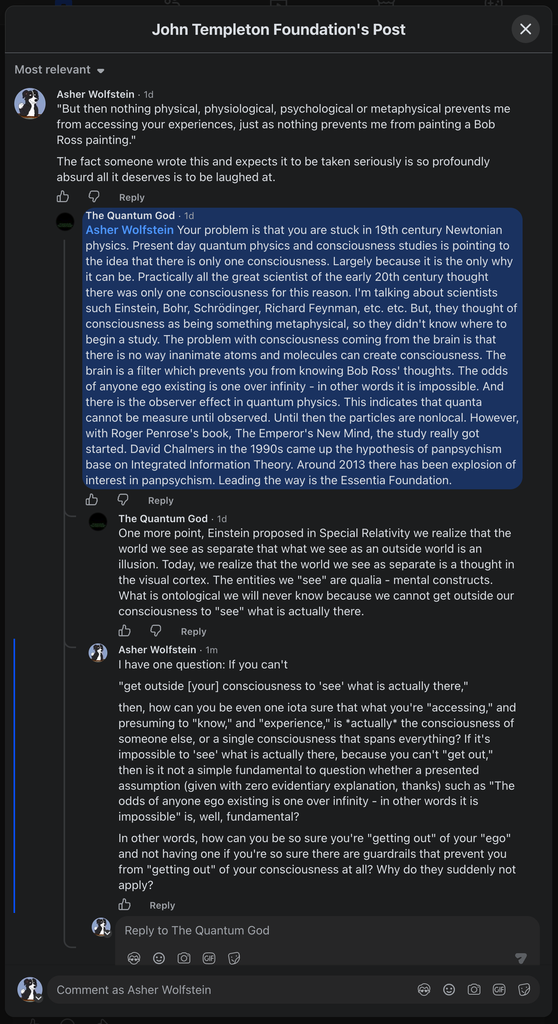
Click To Enlarge
UwU what’s this? Me being contentious on the Internet? Like I have been for the past 25-30 years of my existence? Who knew, right?
Also: 🤮🤮🤮🤮🤮🤮 Get the fuck out of here.
Oh, here it is, the one I like, where some say that a Great Conjunction (oooh!) happened on December 21, 2020 when Jupiter and Saturn were at zero degrees of Aquarius, which many contemporary astrologers mark as the dawn of the New Age, but, you know, a who’s who of nonsense is, well, nonsense.
Oh, believe me, I was really into this shit when I was about 12 to 21, but then I realized how anti-semitic a number of assertions about Judaism (and just anti-anything-else when it came to Christianity and Islam and…) it all was, starting somewhere in the hazy world of Blavatasky’s Theosophy, and how the ever ascending ‘Golden Love’ seemed to shun any real sense of justice or balance or… Judaism, specifically, and how it seeped into a lot of uninspired and derivative canon and well… despite not being a Jew, I kinda was like… yeah, nooooope.
‘Course, I also own the book The Gentle Swastika by ManWoman, so who the fuck knows.
Anyways…
The point of all of this is, when I listen to Aquarius today, I can’t help but reflect on that Maya Angelou quote, “When someo-
*SMACK*
Sorry, turned into a shallow basic bitch influencer-in-their-own-mind…
And in the quiet desolation that exists after any act of violence, I begin to realize that I really seem to like smacking myself for some reason.
If you can’t tell by today’s output, I’m distracted, sure, as always, in that perhaps-obnoxious-charming-peeling-an-onion-like way, but… I’m not distracted.
You see, there are those out there that believe that the Age Of Aquarius is truly the New Age of New Wisdom is truly… the true age of Individualism.
I mean, New Wisdom would mean that, maybe, possibly, it *isn’t* just Altruism ratcheted up to an impossible 3000-power level?
Okay, those “out there” are just me, sorta, and some other dark, disregarded, wild esotericists that like to syncretize everything, but hey, isn’t Guess Who the name of the game?
I come from a surprising background, if you knew my father, Scott, which, no, you didn’t. And that background is Presbyterianism, which, for a bit in that transitionary period between the childlike innocence of rejecting original sin and the fully mature adult of rejecting original sin, I was into Christian symbolism, and particularly, if you couldn’t tell from my craptastically cringéééé high school play Straight To He- I mean, On Being Different, the rejection of the (sometimes caricatured) Christian god.
And so, according to many Christian writers, any movement that focuses on global unity and self-realization, particularly ones that speak of a golden age of harmony through truly-collective thinking, truly-collective technological growth, and truly-collective spiritual enlightenment (psst, you’re in the way troublesome ego with all your contentious arguments), mimic biblical warnings about the End-Times, and they justify this with various, sometimes absurdly-magical-thinking inanities in their endless critiques of esoteric agendas.
And, here’s a thought, what if it is?
What if it is a great deception the likes of which might make the Gnostics salivate again?
Aren’t the End-Times all about the reign of the anti-christ(s) and Lucifer, and Hell, lust, greed, self-indulgence, and all that?
Aren’t they always lining up with calls of, “Oh no, we’re entering the dreaded Roman Alleged-Vomitariums/Weimar Republic and everyone’s queeeer”?
I mean, personally, *I’ve* always wondered about how we’re all supposed to reach ultimate spiritual fulfillment when we’re not even ourselves anymore, but then again, I thought Judas belonged in heaven, so what the fuck do I know? *takes a drag and queens himself*
Well… here we are again!
Again?
Who better to embrace than a veritable anti-christ agent of darkness having crawled out of the abyss, having stepped out of the ninth gate, verbosely touting the virtues of radical individualism and the esotericism of Lucifurryanism?
What I’m trying to say, in all this fancy and pomp, is that the Age Of Distraction?
It’s over.